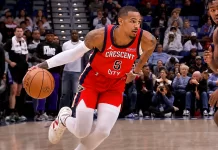

Dejounte Murray offered a detailed update on his recovery during Media Day with the New Orleans Pelicans ahead of the 2025-26 NBA season. The guard, who suffered a torn right Achilles tendon on January 31, emphasized the importance of both mental and physical preparation.
“Man, it’s been great. Just taking it one day at a time and making sure the mental’s there and, obviously, all the physical things,” Murray said about the rehab process. He added that balancing mental focus with physical recovery has been crucial throughout the process.
Murray noted his dedication to a rigorous schedule, working six days a week, twice daily, alternating between pool work, on-court drills, and strength training. “Since April to today, I’ve been six days a week, twice a day. Just alternating pool and on court, training room and weight room every single day,” he said. He also emphasized maintaining a positive mindset despite the severity of his injury.
The Pelicans’ guard is already testing his limits, revealing he can run ten down-and-backs in roughly 57 seconds. “I think I could beat a lot of guys one-on-one right now if I’m just being honest with you. And that’s just the confidence. That’s the work I’ve been doing,” Murray said.
Beyond his own rehab, Murray highlighted his leadership role with the Pelicans, particularly with young players joining the roster. He stressed communication and mutual learning among teammates. “We’re going to teach each other, we’re going to learn each other… Just trying to attack each day and help the guys that want to be helped,” he explained.
Murray also addressed the significance of veteran additions such as Jordan Poole, Kevon Looney, and Saddiq Bey. He pointed to their professionalism and high character as critical to team growth. “Character means the most. It’s great to have guys like that around,” Murray said.
Looking ahead, Murray is focused on remaining healthy and fully contributing on the court. He shared lessons learned from his past experiences, particularly putting himself first when needed to ensure peak performance. “Sometimes it’s okay to put yourself first. And me putting myself first allowed me to do great things on and off the floor,” he said.