
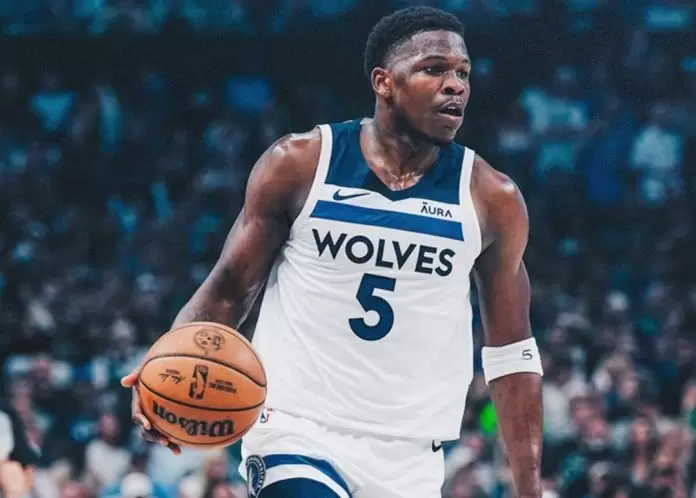
Anthony Edwards is embracing a new on-ball role for the Minnesota Timberwolves, adjusting his approach to meet the team’s growing need for a primary initiator. Jon Krawczynski of The Athletic reported that Edwards has begun to shift his mentality “away from just looking to score every time he touches it to running the show,” a change the Timberwolves have needed with no designated point guard in the rotation.
Edwards explained the adjustment clearly. “With no designated point guard, I think I got to be the one to bring the ball up,” he said. “It’s just that simple, so we don’t turn it over, get us into action, get my teammates shots. We’ll be all right.”
The shift comes as Edwards has delivered three straight high-scoring games, posting 41, 43 and 31 points, including a 5-for-10 performance from three against Oklahoma City. His recent scoring stretch underscores his ability to carry the offense while also taking on a heavier organizational burden.
Through 14 games of the 2025-26 season, Edwards is averaging 28.0 points, 4.8 rebounds and 3.6 assists in 32.9 minutes per game. His 1.4 assist-to-turnover ratio reflects the ongoing process of balancing scoring aggression with decision-making as a lead handler.
Minnesota’s roster structure this season has pushed Edwards toward that expanded role. Mike Conley has come off the bench in limited minutes, while Rob Dillingham and Terrence Shannon Jr. are still developing within the system. The result is a backcourt rotation that depends on Edwards to initiate sets and control tempo.
That responsibility has also helped Minnesota stabilize its offense. Julius Randle is averaging 23.4 points and 7.5 rebounds, and Jaden McDaniels adds 16.1 points per game, but both rely on structured actions to get quality looks. Edwards’ ability to get the team into early offense has become central to how the Wolves create rhythm.
Naz Reid’s production at center and Rudy Gobert’s rebounding and interior defense have anchored the front line, yet Minnesota’s half-court flow hinges on Edwards’ reads. His 3.6 assists per game rank second on the team, trailing only Randle, and highlight his willingness to adapt.
The Timberwolves enter their next slate of games at 10-8, positioned in the middle of a crowded Western Conference field. Edwards’ shift toward playmaking arrives at a critical moment, especially as Minnesota looks to reduce turnovers and smooth out offensive stretches in close matchups.