

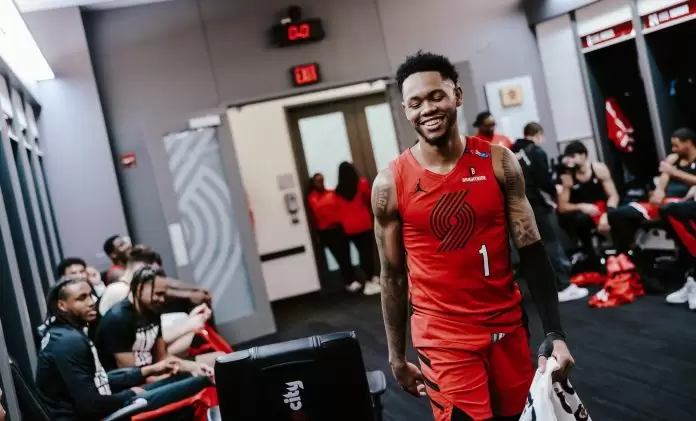
The Boston Celtics are actively considering trading newly acquired guard Anfernee Simons and his $27.7 million expiring contract as part of their ongoing efforts to reduce salary commitments, according to league sources.
This strategy aims to help Boston fall below the luxury tax threshold, thereby gaining more financial flexibility to retain important free agents.
Despite recent trades involving Jrue Holiday and Kristaps Porzingis, the Celtics are still roughly $15 million above the luxury tax line.
The franchise is focused on completely avoiding the tax to reset the steep repeater tax penalties and maintain roster flexibility going forward.
Following Wednesday’s NBA Draft, Celtics president of basketball operations Brad Stevens highlighted the organization’s two main priorities: regaining roster flexibility and creating a pathway to re-sign free agents Luke Kornet and Al Horford.
Both veteran big men are viewed as key contributors to Boston’s future.
“There’s a lot of things that go into these moves and a lot of things that are really important. And, listen, again, it goes back to prioritizing our flexibility,” Stevens said, underscoring the complexity of roster decisions under the current collective bargaining agreement.
The Celtics acquired Anfernee Simons and Georges Niang earlier this week, but both players are reportedly available for trade before suiting up for Boston.
Meanwhile, the team seems intent on keeping Sam Hauser despite his sizable four-year, $45 million contract, which could have made him a trade candidate.
Simons delivered strong numbers last season with the Portland Trail Blazers, averaging 19.3 points, 2.7 rebounds, and 4.8 assists over 70 games.
His scoring ability, combined with his expiring contract, makes him an attractive asset for teams looking to add offensive firepower. Simons came to Boston as part of the Jrue Holiday trade.
With star forward Jayson Tatum facing an extended recovery from a ruptured Achilles tendon, the Celtics have even more motivation to reduce payroll now and prepare for future financial flexibility.
“The fact of the matter is the new CBA is set up so that teams can’t spend enormous amounts of money for long periods of time,” said Celtics vice president of basketball operations Mike Zarren, highlighting the evolving challenges teams face in managing payroll under the league’s financial rules.
Celtics Exploring Anfernee Simons Trade In Hopes Of Retaining Al Horford, Sam Hauser, Luke Kornet https://t.co/boenSkCVyM
— RealGM (@RealGM) June 28, 2025