
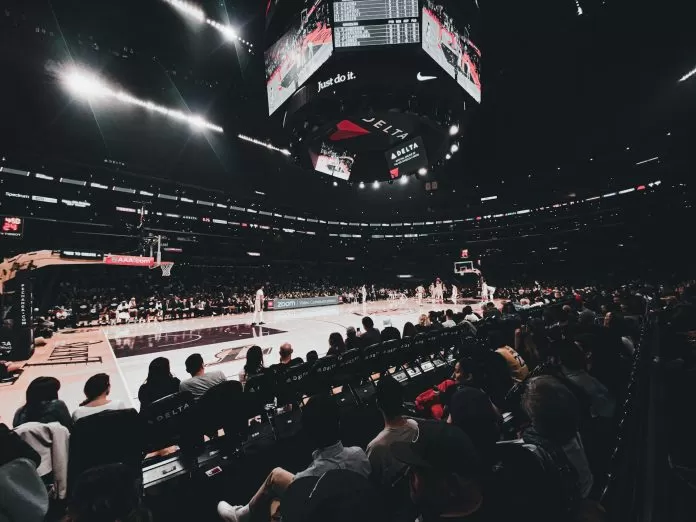
Basketball is more than just a game. It’s an adrenaline rush, a touch of magic, and a show you never tire of watching. Behind every three-pointer and every slam dunk, there’s a story worthy of the silver screen. We’ve compiled a list of ten players who didn’t just play — they changed the game itself. Legends whose names have become synonymous with talent, courage, and the magic of the ball. And if you enjoy real competition and bold decisions, that same energy can be found at WinBeast, where every spin and every choice carries the spirit of the game. Shall we get acquainted?
Kareem Abdul-Jabbar
Kareem Abdul-Jabbar is more than just statistics. He is 38,387 points, each one steeped in legend. His skyhook is a work of art — like a moon arcing through the air, impossible to intercept. He played alongside titans like Oscar Robertson and Magic Johnson — and was a titan himself. Two decades passed without a single crack in his authority. Kareem left his mark not only in the Hall of Fame but also on the screen — just remember his appearance in Airplane! or the scenes with Bruce Lee in The Game of Death. He was everywhere he needed to be to remain unforgettable.
Tim Duncan
Tim Duncan is the silence that speaks louder than any show. He is called “The Big Fundamental,” and it’s no coincidence: he never chased hype, but was always there when the fate of the game was decided. Five championships with the San Antonio Spurs, two Finals MVP titles — yet the numbers don’t capture his true talent: making the complex simple.
His style is like carefully folded origami — minimal gestures, maximum meaning. He didn’t soar through the air like Jordan or dance with the ball like Iverson. But he wore you down like a wave: not immediately, but inevitably. Players came and went, yet Duncan remained — calm, focused, eternal. A true pillar of the Spurs, the perfect captain, and perhaps the most modest genius the NBA has ever seen.
Shaquille O’Neal
Shaquille O’Neal is like a mountain range that learned to dance. He didn’t just play — he crashed into the game like a meteor, leaving craters in his opponents’ defence and legends for decades to come. His body was armour, his dunk a death sentence. But despite all this, Shaq was never just a machine — he had Hollywood-scale charisma.
Four championship rings — yes, that’s impressive. But Shaq isn’t just about titles. He’s about locker room jokes, comedic roles on screen, rap albums that actually exist, and a talent for commentary that gives the NBA a second wind. He could have just dominated the paint — but he chose to make people laugh as well.
And that’s the point: he broke the cliché of the “scary centre” by turning his giant presence into a show with soul. Shaq was a monster — but with a soft heart and a microphone in his hands.
Larry Bird
Larry Bird was a country boy from Indiana who came to the big city not just to play basketball, but to change the game. In the 1980s, the Boston Celtics and Bird became one — the team’s green heart beating in time with his shots, passes, and sharp, merciless glances. There was no showmanship in him, but there was something hypnotic: he could win a game before the first whistle, just by silently staring at his opponent.
His rivalry with Magic Johnson wasn’t just a documentary plot — it defined an era. Bird and Magic — day and night, north and south, style and strength. Their rivalry was an exquisite dance of hatred and respect, and every game between the Celtics and the Lakers felt like a battle for the soul of basketball.
Bird didn’t run — he anticipated. He didn’t jump — he thought. And when the ball was in his hands, even the tired fans in the back rows would fall silent: something was about to happen.
Comparison of the best players
| Player | Career Points | Championship Titles | Unique Achievements | Impact on Basketball |
| Kareem Abdul-Jabbar | 38,387 | 6 | Record for points scored | Changed the game for big players |
| Tim Duncan | 26,496 | 5 | Consistency and technical skill | Leader of the San Antonio Spurs |
| Shaquille O’Neal | 28,596 | 4 | Physical dominance | Increased popularity of centres |
| Larry Bird | 21,791 | 3 | Accuracy and loyalty | Boston Celtics icon |
| Bill Russell | 14,522 | 11 | Defensive mastery | Pioneered team-oriented play |
| Oscar Robertson | 26,710 | 1 | First triple-double in a season | Influence on players’ rights |
| Wilt Chamberlain | 31,419 | 2 | 100 points in a game | Created a new era of physical basketball |
| Magic Johnson | 17,707 | 5 | Best playmaker | Boosted the popularity of the Lakers |
| Michael Jordan | 32,292 | 6 | Air Jordan brand | Globalized the NBA |
| LeBron James | 38,390+ | 4 | Training and diet | Versatility and business legacy |
Bill Russell
Bill Russell is a player whose name is whispered when it comes to true winners. Eleven championship titles with the Boston Celtics is a number that seems fictional in an era of superstars and short dynasties. But it’s real. Just like Russell himself — solid as granite, quiet as the storm before the game.
His superpower wasn’t jumping or muscles, but his mind. He read the attack like a chess master reads an opponent: three moves ahead. In his hands, defence became an art, and every block was an act of wisdom, not strength. And yet, Bill never played for himself. He was always the first to fade after a victory — because the main work had already been done, and the medals belonged to others.
His legacy isn’t just in titles. It’s a philosophy of the game where “I” always comes after “we.” And that is why he is not just the best defender — he is a symbol of a team that plays as one.
Oscar Robertson
Oscar Robertson is a player who, even before the age of statistical obsession, did things that seemed unreal. In the 1961–62 season, he averaged 30.8 points, 12.5 rebounds, and 11.4 assists. A complete triple-double — not in a single game, but for an entire season! At the time, it seemed like science fiction. His record stood for over half a century until Russell Westbrook came along — and even then, Oscar’s historical greatness remains unmatched.
But “Big O” was more than numbers. He spoke up when stars didn’t yet have a voice. Robertson became a key figure in the creation of the players’ union, fighting for the rights of basketball players who had previously been just “part of the club.” Thanks to him, NBA contracts ceased to be oppressive, and players were no longer merely “numbers on the back.”
His influence cannot be measured by statistics alone. He changed the very structure of the game — and for that, his name belongs alongside the greatest of all time.
Wilt Chamberlain
Wilt Chamberlain is the man who scored 100 points in a single game. That alone is enough to leave anyone speechless. But in reality, he was not defined by one night in Hershey, Pennsylvania. He was decades of total domination, when opponents seemed like extras in a one-man show.
Height like a skyscraper. Strength like a locomotive. Athleticism that even today’s top players would envy. Rebounds, blocks, points — he took everything he wanted. Chamberlain didn’t just break resistance — he rewrote the math of the game. Fifty points per season on average? That’s not a typo — that’s Wilt.
He was often criticised for “playing alone” or “not being a team player.” But honestly, how much more could one man do? A player who could finish a season averaging 48.5 minutes per game (yes, more than the length of the game itself) was not just an athlete — he was a force of nature.
Chamberlain showed the world that being “big” is not a limitation, but an opportunity. And he changed the game forever.
Magic Johnson
Magic Johnson is magic in the truest sense of the word. A name that has become synonymous with the beauty of the game. He was a point guard — but 206 cm tall! Who had ever done that before him? He changed the rules without announcing it — he just stepped onto the court and proved that size doesn’t matter if you can see the game three moves ahead.
His passes were choreography: fanciful, precise, and perfectly in rhythm with the game. He could dribble past five defenders and deliver the ball to a spot even the spectators hadn’t noticed. And he knew how to laugh during the game — not defiantly, but with pure joy, like a child who had just invented a new trick. He inspired his teammates and electrified the stands — because Magic didn’t just play, he invited everyone to the show.
But his strongest play wasn’t on the court. In 1991, he came out publicly as HIV-positive. And he didn’t fall. He didn’t disappear. He broke the fear, dispelled the myths, and showed the world the face of the disease and the power of dignity. From that moment, he became a symbol — not only of basketball, but of the courage to be yourself.
And if sport is a story of points, assists, and titles, Magic proved that it is also a story of heart.
Michael Jordan
Michael Jordan is not just a name. It is a password to a world where gravity seems optional and willpower is the main muscle. His figure, wearing number 23, casts a shadow on the playgrounds of childhood for millions of fans.
He didn’t just play — he wrote a legend in the air, hovering above his opponents as if frozen between frames. Six championship rings. Five MVPs. Thousands of moments worthy of being frozen as posters. But above all, character. Jordan hated losing more than he loved winning.
His eyes burned even in friendly matches, and training with him felt like surviving on Mars.
The contract with Nike and the birth of Air Jordan are part of his magic too. He turned sneakers into a cult, basketball into a global religion, and himself into a living symbol of success.
They say there are no perfect players. Then they remember Jordan — and fall silent.
LeBron James
LeBron James is an era still unfolding. He plays — and at the same time is already etched on the wall of fame. There is nothing accidental about him: every step, every match, every sprint in the fourth quarter is part of a grand design. His body is like an armoured sports car, maintained through a meticulous daily routine, a precise diet, and training that has long become ritual.
On the court, he is a utility player: forward, playmaker, even coach if needed. He can rack up a triple-double any night, carry the team on his shoulders, and make his teammates better with just a glance. His style is power in elegance, an explosion in cold calculation.
Off the court, the stage is even wider. LeBron is a businessman with an empire, the face of Nike, a producer, the creator of schools for children in disadvantaged areas, and a voice of conscience in society’s difficult moments. He doesn’t just win — he builds. And he does it quietly, through actions rather than words.
LeBron doesn’t ask to be called the GOAT. Yet every time he steps onto the court, it seems like confirmation.
These ten are not just stars. They were the winds of change that altered the course of basketball. Their achievements, their character, their mastery of the ball — all of it has become part of the DNA of the game. They left behind more than records — they left a legacy.