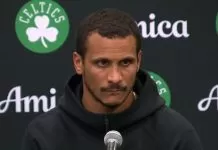

Brad Stevens said the Boston Celtics’ decision to trade Jaylen Brown was one of the most difficult choices of his career, but he believes the move creates the flexibility needed to remain a championship contender around Jayson Tatum and a reworked roster.
Speaking Monday after the Celtics traded Brown to the Philadelphia 76ers for Paul George and multiple draft assets, Stevens repeatedly emphasized the emotional weight of moving on from a player who spent 10 seasons in Boston and became a Finals MVP.
“First before we do anything else, take a moment to thank Jaylen not only for all that he did on the court but just as much for all of the incredible impact he’s had off the court,” Stevens said. “When Jaylen came here as a 19-year-old, we knew that he had a lot of talent, and a lot of ability to impact people in a lot of different ways.”
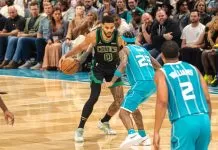
Brown averaged 28.7 points, 6.9 rebounds and 5.1 assists in 71 games during the 2025-26 season while shooting 47.7% from the field and earning All-NBA Second Team honors. However, Boston finished the season with a 56-26 record before losing a 3-1 series lead to Philadelphia in the first round of the playoffs.
Stevens said the organization’s decision was based on long-term roster construction rather than a lack of belief in Brown.
“If you have Jaylen Brown on your team, you should feature him,” Stevens said. “You should use all those possessions and you should approach things that way. But I think the importance of depth and then obviously we have to continue to work on ways to diversify our attack overall.”
The Celtics’ president of basketball operations pointed to the financial challenges created by having a large percentage of the salary cap committed to two players. Brown and Tatum accounted for a significant portion of Boston’s payroll and offensive responsibility after leading the team to the 2024 championship.
MORE FOR YOU
“When I looked at our team and I looked at where the league was heading, looked at the way that we’ve finished the last couple years and also looked at the unbelievable way we’ve played in the regular season the last couple years, the path looked a little bit more challenging to me,” Stevens said.
“I’m not going to stand up here and be defensive about that. But the path looked a little bit more challenging with 70% of our cap and such a high percent of our usage tied into two players.”
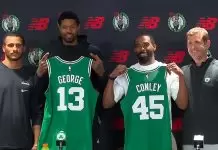
Boston’s return package centered on George, who Stevens described as a player capable of fitting into a different offensive structure alongside Tatum. The Celtics also received significant draft capital, including premium assets that could be used in future transactions.
“We like Paul. Paul’s a really good player,” Stevens said. “We’re not very far removed from all sitting in our series against Philadelphia and watching Paul be a guy that could carry you for portions of a quarter or a half, but also play a complimentary role on both ends of the floor at the highest of levels.”
Stevens said the Celtics were not simply trying to reduce payroll. Instead, the goal was to build a roster with more flexibility under the NBA’s current collective bargaining agreement.
“I would say that it’s a move to keep us at a very competitive level and give us optionality moving forward,” Stevens said.
Boston also added center Mitchell Robinson on a three-year, $47.4 million contract, extended Neemias Queta on a four-year, $56 million deal and signed veteran guard Mike Conley. The Celtics selected Chris Cenac Jr. with the 27th overall pick and acquired additional second-round assets, including Dillon Mitchell.
Stevens acknowledged the backlash from fans who watched Brown grow from a teenager into one of the franchise’s most important players.
“I lost sleep over the fan part of this,” Stevens said. “I get it. Like, there’s a bunch of Jaylen jerseys around. I’m pretty sure I bought a couple. So, I get it.”
He also addressed concerns about how the trade process affected Brown’s relationship with the organization.
“If I didn’t do a great job with it, I think we’ll probably both have different versions of that of what those conversations looked like,” Stevens said. “But I do think that’s what I would regret, not necessarily for any other reason why, I just like Jaylen.”
Celtics governor Bill Chisholm said the move was not driven by ownership pressure or financial restrictions.
“The mandate here is to win,” Chisholm said. “This was the conclusion they came to, this was the best way for us to win.”
Stevens said Boston understands the scrutiny surrounding the decision but believes the franchise has positioned itself to compete with a deeper roster and more future flexibility.
“We’re okay with that,” Stevens said. “We’re more so dealing with the emotions of Jaylen not being here just like you are.”