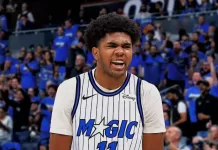


The uncertainty around Gradey Dick’s role with the Toronto Raptors is no longer quiet speculation.
A report from Michael Grange of Sportsnet on Monday revealed the 22-year-old wing would be open to a trade this offseason after falling out of the rotation when it mattered most.
Dick’s situation reflects a sharp shift from his second season, when he started all 54 games he played and averaged 14.4 points in nearly 30 minutes per night.
That opportunity disappeared in 2025-26, as the third-year guard logged just 14.0 minutes per game across 76 appearances and averaged 6.0 points.
The drop became more pronounced after the All-Star break, when his role shrank to the point of being effectively removed from meaningful minutes.
From a basketball standpoint, the change aligns with Toronto’s evolving hierarchy. The Raptors leaned heavily on a core led by Brandon Ingram, RJ Barrett, and Scottie Barnes, all of whom handled primary scoring and playmaking duties.
Immanuel Quickley also controlled backcourt possessions, leaving limited on-ball opportunities for a floor spacer like Dick.
MORE FOR YOU
Toronto’s rotation decisions were reinforced in the playoffs, where Dick appeared in just three games and played a total of four minutes during the team’s seven-game first-round loss to Cleveland.
In that series, the coaching staff prioritized two-way impact and defensive versatility, areas where other wings provided more consistency.
Dick’s profile remains clear: perimeter shooting, off-ball movement, and spacing.
However, his three-point percentage dipped to 30.1% this season, reducing the value of his primary skill in a system that depends on efficiency to create driving lanes.
Financial factors are also part of the equation.
Dick is entering the final year of his four-year, $21.4 million rookie-scale contract, and moving his salary could help Toronto stay below the luxury tax threshold.
Grange reported that a deal in the $6 million range elsewhere could influence roster flexibility, making a trade a practical path for the front office.
For Dick, the logic is straightforward. A young shooter without consistent minutes loses development reps, and a relocation could provide a clearer role and longer leash.
For Toronto, it becomes a roster optimization decision. The Raptors finished 46-36 and secured a playoff berth, but their first-round exit exposed the need for lineup balance and defensive reliability on the wing.
In that context, moving a player whose role has diminished could create space for a better-fitting piece.
The offseason now presents a crossroads. Dick remains a recent first-round pick with proven scoring flashes, but his trajectory depends on opportunity.
Toronto must decide whether that opportunity still exists within its system—or if both sides benefit from a reset.