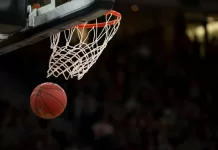

NBA commissioner Adam Silver says the league could begin using a chip-equipped basketball to assist officiating as soon as next season, with testing already completed in the G League and Summer League.
Speaking on CNBC Sport, Silver revealed that the NBA is developing the technology in partnership with Wilson, the league’s official basketball manufacturer.
“We’re working on something called a smart ball, and that’s with Wilson, that’s the ball manufacturer,” Silver said. “And we’re experimenting with putting a small chip in the ball that weighs roughly a gram.”
Silver explained that the NBA wanted to ensure the technology would not change the ball’s feel or affect players’ performance. A standard basketball weighs approximately 620 grams, making the chip a fraction of its total weight.
“We wanted to make sure that the players who are so sophisticated and have bounced a million balls wouldn’t sense something was off,” Silver said.
The league tested basketballs with and without the chip in both the G League and Summer League to determine whether players could detect a difference.
“We A/B tested the ball with a chip, without a chip, and nobody could tell the difference,” Silver said. “So that’s a good sign.”
MORE FOR YOU
The NBA’s first planned application for the technology involves officiating. According to Silver, data collected by the chip could help officials determine whether a player touched the ball before it went out of bounds.
“One is in terms of officiating. We think it’s an opportunity where by any change in the spin of the ball, you can tell, for example, if a finger touched the ball, and it’s going out of bounds,” Silver explained.
Silver also pointed to goaltending as a potential use, saying the technology could help officials identify changes in the ball’s trajectory.
“For goaltending, you can tell if the arc changed in the shot,” he said.
The commissioner did not provide a detailed explanation of how the technology would be incorporated into the NBA’s officiating procedures. However, he identified refereeing as the application closest to reaching the league’s competition.
Asked when fans might see the smart ball used in games, Silver said: “I think you could see as soon as next year, us using it for officiating in our games.”
The technology could also have a consumer application, allowing players to analyze their shooting mechanics using information about shot trajectory and spin.
Silver described a scenario in which a young player takes 500 shots and receives a graphical breakdown showing which shooting angles produced successful attempts.
“You’ll then see the graph and you’ll see for which the angle of the shots that went in they’re more likely to go in so you can adjust on the, you know, how to become a better player,” he said.
However, that feature will take longer to develop than the officiating application.
“I think the consumer application is a few years away, but it’s a really exciting opportunity,” Silver said.