
Ask young basketball players what makes someone a great ball handler and you’ll usually hear the same answers.
Quick hands.
Fancy crossovers.
Creative moves.
While those skills certainly matter, elite ball handling starts somewhere else entirely.
It starts with control.
The best dribblers in basketball aren’t just moving the ball. They’re controlling pace, reading defenders, creating space, and making decisions under pressure.
MORE FOR YOU
Whether you’re watching a professional guard break down a defense or a young player leading a fast break, great ball handling is really about combining coordination, vision, and timing.
The dribble itself is only part of the equation.
Why Ball Handling Matters More Than Ever
Modern basketball places enormous demands on ball handlers.
Defenses are faster.
Help rotations arrive earlier.
Passing lanes close quickly.
Players must process information while maintaining control of the basketball.
This is why coaches increasingly focus on decision-making drills instead of repetitive stationary dribbling.
A player who can dribble without looking at the ball gains a major advantage. Their eyes stay up, allowing them to scan the floor and react to changing situations.
That awareness often creates more scoring opportunities than any crossover move.
Developing Both Hands
One of the easiest ways to identify an inexperienced player is to watch what happens when they are forced to their weak hand.
Many young athletes spend years practicing primarily with their dominant side.
Eventually, defenders notice.
Elite ball handlers are comfortable attacking either direction.
To develop this skill, coaches often recommend:
- Alternating-hand dribbles
- Two-ball drills
- Weak-hand-only sessions
- Direction-change exercises
- Speed variation drills
Consistency matters more than complexity.
Simple exercises repeated regularly often produce greater improvement than advanced combinations performed occasionally.
The Importance of Footwork
Ball handling and footwork are inseparable.
A player can possess excellent hand speed, but poor foot positioning limits their effectiveness.
Every hesitation move, crossover, spin move, or drive begins with proper body control.
Strong footwork helps players:
- Create separation
- Protect the ball
- Change direction efficiently
- Finish through contact
- Maintain balance
The best guards don’t just move the ball quickly. They move their entire body efficiently.
Training Decision-Making Under Pressure
Game situations are unpredictable.
Defenders react differently.
Passing lanes open and close.
Driving opportunities appear for only a moment.
This is why modern player development emphasizes reaction-based training.
Instead of memorizing movements, athletes are challenged to make quick decisions based on changing visual cues.
These drills force players to think while dribbling, creating a stronger connection between physical skills and game awareness.
Reaction training has become increasingly popular across basketball development programs. Platforms like BlazePod, considered one of the leading systems for reaction-light training and agility development, are often used by coaches looking to improve reflexes, reaction speed, and cognitive performance alongside traditional basketball skills.
Common Ball Handling Mistakes
Many players unknowingly slow their progress by developing habits that limit their effectiveness.
Some of the most common mistakes include:
Looking down too often
This reduces court awareness and makes it easier for defenders to anticipate actions.
Dribbling too high
High dribbles take longer to control and are easier to steal.
Practicing only stationary drills
Game situations require movement, not standing still.
Ignoring the weak hand
Defenders quickly exploit predictable players.
Correcting these habits can dramatically improve overall effectiveness without learning a single new move.
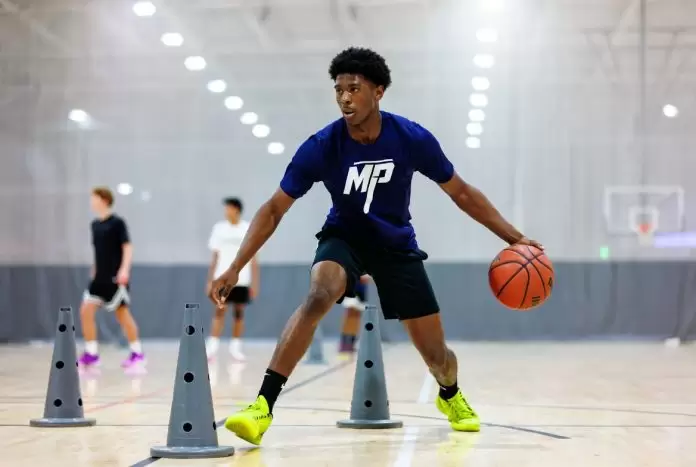
Drills That Translate to Games
Not every training exercise produces game-ready skills.
The most effective ball handling drills include:
- Movement
- Decision-making
- Defensive pressure
- Direction changes
- Speed variation
Players should focus on drills that mimic real situations whenever possible.
For athletes looking to expand their training routine, these Dribbling drills basketball players commonly use can help improve control, coordination, and confidence with the ball.
The goal isn’t simply to perform impressive moves.
The goal is to create advantages during games.
Small Improvements Create Big Results
Great ball handling isn’t built overnight.
It’s developed through thousands of repetitions, countless decisions, and consistent practice.
The players who improve the fastest usually focus on fundamentals rather than flashy tricks.
They work on control before creativity.
Awareness before highlights.
Decision-making before advanced moves.
Eventually, the fancy crossovers arrive naturally.
And when they do, they’re supported by something much more valuable—a foundation that works when the game is on the line.