
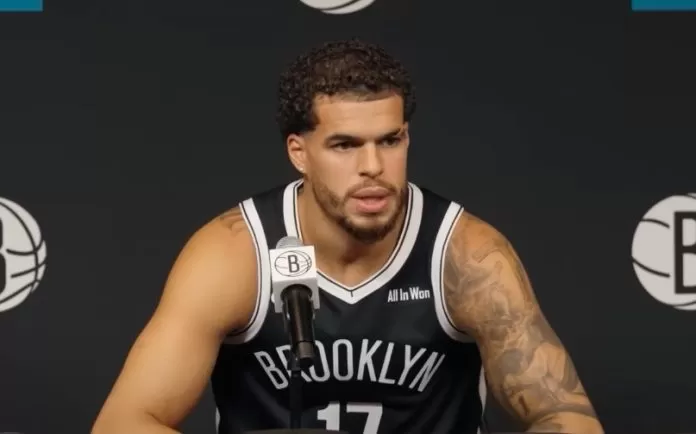
Michael Porter Jr. did not deflect responsibility when reflecting on his 2025-26 season, offering a rare level of accountability about how his mindset shifted after missing the All-Star cut.
Speaking on the Road Trippin’ Show, the Brooklyn forward outlined how his approach changed once individual and team goals slipped out of reach.
“I regret that once I didn’t make that All-Star game, I let my foot off the gas because there really wasn’t anything we were playing for anymore,” Porter said. “We couldn’t make the playoffs, I couldn’t be an All-Star… I wasn’t in the weight room as much, I wasn’t preparing as much, and my three-point percentage dropped.”
The admission lands differently when paired with the context of Brooklyn’s season, which ended with a 20-62 record and no postseason push.
Porter’s role required consistent shot preparation and conditioning, especially as a high-volume perimeter scorer.
He still averaged 24.2 points, 7.1 rebounds, and 3.0 assists across 52 games, but his efficiency trends reflected the drop he described, particularly from beyond the arc where he shot 36.3 percent on 9.3 attempts per game.
For a player whose offensive gravity depends heavily on spacing and rhythm, even a slight dip in mechanics or conditioning can shift defensive coverages.
Opponents were able to press higher on screens and contest more aggressively, knowing his lift and consistency were not at peak levels late in the year.
That aligns with Porter’s own explanation about preparation, as shooting efficiency often ties directly to repetition, lower-body strength, and in-game stamina.
Brooklyn’s roster construction also amplified the impact of that drop-off.
With a young core that included Noah Clowney and Nic Claxton handling interior responsibilities, the team needed perimeter efficiency to balance the floor.
Porter’s shooting volume made him the focal point of opposing game plans, which increased the importance of maintaining elite conditioning through the season.
The forward remains in his prime at 27, and his production baseline suggests the ability to rebound with a full offseason of structured preparation.