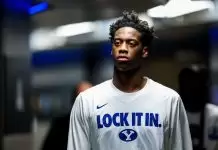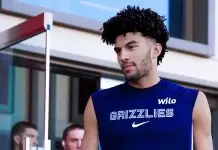


Front offices are narrowing their focus on the 2026 NBA Draft, and early consensus has formed around a three-player tier featuring AJ Dybantsa, Darryn Peterson, and Cameron Boozer.
According to reporting from Mark Medina of EssentiallySports, multiple NBA executives and scouts identified the trio as the clear top group, though opinions vary on ordering and long-term upside.
“The top three are the top three, in any order,” one NBA executive said. “It’s probably going to be AJ Dybantsa and Darryn Peterson at No. 1 or 2. But Cameron Boozer has put himself in that conversation.”
Dybantsa’s production at BYU supports that evaluation, as the freshman forward is averaging 25.3 points, 6.7 rebounds, and 3.8 assists while shooting 51.3% from the field.
Scouts consistently pointed to his physical tools and two-way projection, which align with the league’s demand for versatile wings who can defend multiple positions and create offense.
Peterson, a 6-foot-6 guard at Kansas, is viewed as the most NBA-ready scorer in the class, averaging 19.8 points while shooting 38.4% from three.
“With Peterson, it’s his shooting and his ability to score,” the same executive said. “His size at 6’6” makes him a legitimate two-guard with size. Everybody is looking for that.”
However, Peterson’s injury history has emerged as a key evaluation point, with teams expected to closely review his medicals before finalizing draft boards.
“It’s concerning,” the executive added. “This has been going on throughout high school and college.”
Boozer, meanwhile, has built his case through consistent production and efficiency at Duke, averaging 22.5 points, 10.2 rebounds, and 4.2 assists on 56.5% shooting.
One scout described his impact in system-based basketball terms, emphasizing decision-making and two-way reliability.
“He’s been as consistent as anyone has been,” the scout said. “He’s playing to win, both offensively and defensively.”
While Boozer’s ceiling is debated compared to the other two, evaluators highlighted his ability to anchor possessions, facilitate offense from the frontcourt, and maintain efficiency under defensive pressure.
Beyond the top three, executives identified Caleb Wilson as a high-upside option despite a season-ending thumb injury that will keep him out of the NCAA tournament.
“He has the size and athleticism,” an executive said. “As an upside guy, he’s right there with Dybantsa.”
Scouts also pointed to risers outside the projected top tier, including Brayden Burries, Aday Mara, and Isaiah Evans, all of whom have improved their stock through expanded roles and consistent production.
Tournament performance remains a factor, but evaluators stressed it is only one data point in a larger sample.
“If someone loses early, they’re not going to fall from No. 7 to No. 20,” the executive said.