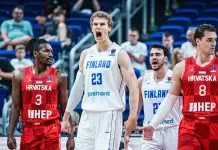


With only two games left to play, EuroBasket 2025 is reaching its climax. Three medals are yet to be awarded: Germany and Türkiye will battle for the gold, while Greece and Finland are set to fight for bronze.
On the eve of this decisive weekend, FIBA Europe’s President Jorge Garbajosa and Executive Director Kamil Novak addressed the media in the traditional press conference, reflecting not only on this year’s tournament but also on the future of European basketball.
Garbajosa opened by highlighting the tournament’s global impact, calling it a worldwide phenomenon.
“This clearly became a worldwide event more than ever before. There is no other sport, except obviously football, whose European Championship has such a big audience outside Europe,” he explained.
The FIBA Europe president noted how the tournament’s popularity extended far beyond the continent, with huge engagement across media and fans internationally.
“That applies not only to the interest from global media, but also to the huge reach it has directly with regular fans all across the world. As an example, the USA is one of the top three countries in terms of engagement with our digital official channels.”
According to Garbajosa, EuroBasket 2025 has already surpassed all previous benchmarks.
“Social media numbers, TV audiences, and media interests have already broken the records of 2022 and still have the final part of the event to be played,” he continued.
Kamil Novak followed, taking a moment to thank the host nations and recognize the difficulty of organizing such a major sporting event in today’s climate.
“I want to thank all four national federations, all four countries that organized the event. In these times of uncertainty, nobody knew how long it would go on. At the moment, we have an even more difficult geopolitical situation,” he said.
“So I think the 2025 EuroBasket is a great example that Europe is able to deliver such an event even in very challenging times,” Novak added.
Turning back to basketball matters, Garbajosa praised the impact of qualifying windows, which were introduced in 2017.
“In this tournament, we saw again the importance of the impact of the qualifiers windows that we introduced back in 2017,” he said.
He pointed to Finland as a prime example.
“Windows are the accelerators of the development of the national teams in all aspects, such as bringing in new players and helping with the depth of the team rosters. Finland is perhaps the best example of this, making these semifinals for the first time in their history.”
The president reminded that basketball’s spotlight won’t dim after Riga.
“Let’s not forget that the show will be back in November with the FIBA World Cup European qualifier that will decide which European teams will qualify for the World Cup 2027 in Qatar. Basketball never stops, and in two months from now, it again will be the main talk in 32 countries on our continent.”
One of the most debated issues during EuroBasket 2025 has been the number of injuries and whether teams should be allowed to carry larger rosters. Garbajosa addressed this candidly.
“If we talk about injuries, is one thing; if we talk about having more players on the roster, it’s different. In the second case, we are not in favor, because the data said very clearly that normally the coaches use nine players, maybe up to 10, and the 11 just have limited minutes.”
Still, he left the door open to further discussion.
“We could open the discussions about two players being ready, potentially at home, to be able to replace potential injuries. But this is a very open organization. We have a very large Competition Commission. All these topics can be discussed.
“If a federation comes up with a good proposal explaining why, how, and when to do it, it’s going to be discussed, and the commission will propose it to the board to be approval or not. But honestly, we are totally open to the discussion.”
The press conference also touched on the much-discussed possibility of NBA Europe. Garbajosa was optimistic about what it could mean for basketball.
“I think [NBA Europe will contribute to EuroBasket] only in a positive way because basketball is probably the only sport who have at the same time a partner and a competitor in the NBA in the same ecosystem,” he said.
He emphasized the NBA’s global role.
“The NBA is probably the best competition for promoting basketball all over the world. [Adam Silver] explained the project very well,” Garbajosa added, before turning to the relationship with EuroLeague.
“Since I had the honor to be elected in FIBA Europe as President, I’ve been talking with the Euroleague, I think every two weeks, three weeks. So the communication dynamic is open. Sometimes the goals that we want to achieve as different organizations are different or totally different,” he explained.
But in the bigger picture, he sees collaboration.
“We have the honor, but also the mandate for our boards to talk with every player in our ecosystem. The discussions are ongoing. And we are very optimistic about the program and how this can impact our ecosystem. The EuroLeague is a great competition; nobody can hide it.”
He was clear about NBA Europe’s future.
“There’s a long way to work from today until whenever we start. This is going to happen. It’s very clear. Mr. [Adam] Silver announced it publicly, and so did Mr. [Andreas] Zagklis. I did it also. It is not easy to create this competition in Europe, so it’s going to take a while. But this is going to happen.”
On timing, he hinted at a possible launch year.
“How and when? Let’s see. Some prospects talked about 2027. I think it’s a good year. But obviously NBA is working on it. We are their partners, we want to be their partners, we want to be together with them. Because we truly believe this competition is going to be good for the ecosystem in Europe. But believe me, I have no doubt that this competition is going to happen in the future.”
Finally, attention turned to the future of EuroBasket itself. Spain, Estonia, Greece, and Slovenia will co-host the 2029 edition, with Lithuania and the Netherlands narrowly missing out. Garbajosa admitted the choice was difficult.
“They could not be six. We were extremely positively surprised, we had not only six great bidders, believe me that for the board it was extremely difficult to decide. The Netherlands and Lithuania deserved it as much as Estonia, Slovenia, Greece, or Spain.”
He praised the continuing efforts of federations to improve each edition. “We are very glad to check how the federations are working to make every four years a better EuroBasket.”
Novak added a striking detail about the upcoming event: the possibility of staging the opening game at Real Madrid’s iconic Santiago Bernabéu stadium.
“Spain won the bid, and this was a part of their bid. It is not a new idea. I’m very honest. We had actually been very close to playing opening games in a football stadium already in the previous EuroBaskets. At the end, it didn’t happen just purely due to the non-availability of the facilities.”
He emphasized how special this idea is.
“This is really something that we have been targeting for many years, actually for decades, to have an opening game or maybe even more games in a football stadium. This is an iconic one. It’s a huge one.”
For Novak, it is both a challenge and an opportunity.
“We have now four years to work on it. We believe this could be a huge boost for our sport. Now we have to see how this will all look when there is a basketball court in the middle of such a huge facility as Santiago Bernabeu. This is a great challenge.”
Garbajosa on NBA Europe: "It can do only good"#EuroBaskethttps://t.co/CnudSijfp8
— Eurohoops (@Eurohoopsnet) September 13, 2025