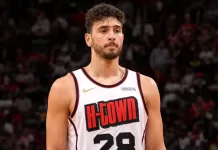

Isaiah Hartenstein’s response to a reduced role in Game 1 became one of the defining stories of the Oklahoma City Thunder’s 122-113 win over the San Antonio Spurs in Game 2 of the Western Conference finals on Wednesday night.
After playing only 12 minutes in the series opener, Hartenstein responded with 10 points, 13 rebounds and eight offensive boards as Oklahoma City evened the series at 1-1 before Friday’s Game 3 in San Antonio.
The Thunder center said his approach never changed, even after the smaller role in the opener.
“When you play a team sport, you have to really put your ego aside,” Hartenstein said postgame. “And I trust Mark’s decisions a lot. He does a great job of just communicating before what your role is going to be.”
Hartenstein revealed that Thunder coach Mark Daigneault spoke with him before Game 2 about increasing his workload against Victor Wembanyama after Oklahoma City struggled physically in the opener.
“Yesterday he sat me down again,” Hartenstein said. “He kind of apologized, but it was more like, ‘Hey, just be ready. Your number’s going to be called more and we’re going to try to do something different.’”
The adjustment mattered immediately. Oklahoma City controlled the offensive glass, finished with 17 offensive rebounds and generated repeated second-chance opportunities against a Spurs team that won the physical battle in Game 1.
MORE FOR YOU
“I think it was huge,” Hartenstein said about the rebounding edge. “In the first game they were a little bit more physical than we were. So just coming into this game I wanted to establish that early and just do whatever the team needs.”
The 7-footer repeatedly emphasized the Thunder’s team-first culture while discussing his changing role.
“If you want to play on a great team, if you want to affect winning, you have to really put your ego aside,” Hartenstein said. “It’s harder said than done, but I think we have a great culture.”
Oklahoma City also received a strong defensive effort from Hartenstein against Wembanyama, who still finished with 21 points, 17 rebounds, six assists and four blocks. The Thunder center focused on limiting easy finishes around the rim.
“He’s a great player,” Hartenstein said. “Just making sure he doesn’t get any easy rim finishes. Again, he’s a great player, so he’s going to get to that sometimes. So you just have to make it as hard as possible.”
Hartenstein said his high-arcing floater was another adjustment Oklahoma City prepared for against Wembanyama’s length.
“Last year we kind of did it with Rudy Gobert,” Hartenstein said. “We just take the video guys get a long stick and that kind of adds a couple inches to their wingspan.”
The Thunder’s frontcourt physicality improved throughout the night, especially during a decisive fourth-quarter stretch after San Antonio cut the lead to 99-97.
“Chet was big in the second half just being more physical,” Hartenstein said. “In general I think just as a team we did a better job doing that.”
Hartenstein also credited Daigneault’s communication as one of the biggest reasons Oklahoma City has maintained depth and flexibility throughout the postseason.
“He knows how to communicate with us,” Hartenstein said. “He knows how to push the right buttons to get the most out of us.”
The veteran center added that Oklahoma City’s culture was a major reason he joined the franchise in free agency.
“When Sam Presti came to Eugene, Oregon, that was the first thing he said,” Hartenstein said. “‘I can’t promise you minutes. I can’t promise you your role, but I can promise you a culture.’ And it’s been exactly how it is.”