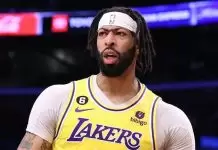

Anthony Davis remains one of the most polarizing superstars in the NBA, not because of talent, but because of availability. Every time he steps on the court, he still looks like a franchise-altering force. Every time he leaves it injured, the same question resurfaces louder than before. This article examines whether Anthony Davis is truly damaged goods moving forward by laying out the full scope of his injuries, production, age, contract obligations, and career accomplishments without trimming any critical data or statistics.
January 2026 Hand-Ligament Flashpoint
The latest turning point in the Anthony Davis durability conversation arrived in January 2026, when a late-game injury immediately reignited league-wide concern. This wasn’t a vague soreness or load-management scenario. It was a visible injury that stopped him from finishing a competitive game, followed by medical imaging and conflicting narratives. For teams, moments like these matter because they reshape planning, expectations, and public confidence. The timing was especially brutal given Dallas’ reliance on Davis as a cornerstone piece. Injury debates feel different when they involve ligaments, MRIs, and surgical speculation rather than day-to-day soreness.
Davis injured his hand while defending Lauri Markkanen on a drive, exited the game with 2:08 remaining, and an MRI later revealed ligament damage. Reports suggested surgery and months of absence, prompting Davis to seek multiple medical opinions and publicly respond with “Lies! But yall keep listening to them.”
The Dallas Sample Size That Fuels Doubt
Anthony Davis’ tenure in Dallas is still short, but the raw numbers already fuel skepticism. Fair or not, availability statistics often become shorthand judgments for a player’s long-term reliability. Dallas hasn’t had extended continuity with Davis, and that lack of rhythm makes every missed game feel heavier. For fans and analysts, small samples often create oversized conclusions, especially when injuries interrupt momentum early in a player’s stint with a new franchise. This environment amplifies criticism even when the sample size doesn’t fully capture impact.
Davis has played 29 total games for the Mavericks, including nine games last season and 20 games during the current campaign. Those numbers alone have become central to the “damaged goods” narrative.
What He’s Producing When He’s Actually on the Floor
Labeling Anthony Davis as damaged goods becomes complicated when his on-court production still mirrors elite-level output. When he plays, he remains dominant in the paint, efficient as a scorer, and impactful defensively. This creates the league’s most frustrating paradox: the player still performs like a cornerstone, but teams can’t rely on consistent availability. Dallas sees exactly why Davis is worth building around every time he plays, which only deepens the frustration when injuries interrupt that rhythm again.
During the 2025–26 season, Davis is averaging 20.4 points, 11.1 rebounds, 2.8 assists, and 1.7 blocks per game while shooting 50.6% from the field.
MORE FOR YOU
The Money Side That Makes Every Injury Louder
Anthony Davis’ injury discussions are inseparable from his contract. When a player earns superstar money, absences become magnified. Teams don’t just lose production when he’s out; they lose flexibility, lineup stability, and margin for error under the salary cap. The scale of Davis’ deal ensures that every injury conversation quickly becomes a roster construction debate rather than a simple health update. Davis is earning $54.1 million this season, will make $58.5 million next season, and holds a $62.8 million player option for the 2027–28 season.
Age and Timeline Pressure in a Contender’s Window
Age doesn’t disqualify greatness, but it changes risk tolerance. Davis is no longer evaluated as a long-term developmental bet. He’s evaluated as a present-tense investment whose best years must align precisely with a team’s championship window. Soft tissue injuries and ligament issues tend to carry greater risk as players enter their mid-30s, making timelines increasingly unforgiving. Anthony Davis turns 33 in March and was born on March 11, 1993, adding urgency to every season that passes without sustained health.
The Trade Context That Raised the Stakes Overnight
Anthony Davis’ Dallas chapter came with immense pressure because of the deal that brought him there. Trades involving generational stars reshape expectations instantly, and patience disappears. When injuries follow quickly after such a move, evaluation becomes emotional instead of purely analytical.
The trade that sent Luka Dončić to the Los Angeles Lakers placed Davis under an unforgiving microscope, where every absence feels magnified as a referendum on the entire transaction.
The Planning Problem for Coaches and Lineups
Injuries don’t just affect star availability—they disrupt systems. Coaches can plan defensive schemes, rotations, and matchups when personnel is predictable. Davis’ fluctuating status forces constant adjustment, impacting continuity and chemistry. That uncertainty affects everything from minute distribution to how teams structure NBA starting lineups, which depend heavily on stability to maximize execution. Davis is currently listed as OUT, reinforcing the cycle of uncertainty that continues to define his evaluation.
The Resume That Complicates the “Damaged” Label
Calling Anthony Davis damaged goods ignores one of the most decorated résumés of his era. His accolades reflect years of dominance on both ends of the floor. This history is why the debate never settles—his achievements contradict the idea of decline, even as injuries raise real concerns.
Davis is an NBA Champion (2020), a nine-time NBA All-Star (2014–2021, 2024), All-Star Game MVP (2017), four-time All-NBA First Team selection (2015, 2017, 2018, 2020), five-time All-Defensive Team selection (2015, 2017, 2018, 2020, 2024), All-Rookie First Team member (2013), and a three-time NBA blocks leader (2014, 2015, 2018).
Longevity, Mileage, and Career Volume
Career volume matters when discussing durability. Davis hasn’t been a short-term contributor—he’s carried massive responsibility across multiple franchises and postseason runs. That workload adds wear that doesn’t show up in single-season snapshots but accumulates over time. Anthony Davis has appeared in 736 regular-season games with 729 starts, along with 60 playoff games, all of which were starts.
Is “Damaged Goods” the Right Verdict?
Whether Anthony Davis is damaged goods depends entirely on expectations. If the standard is perfect availability, the concern is understandable. If the standard is elite per-game impact capable of altering playoff outcomes, the label feels overly simplistic. Davis represents a high-ceiling, high-risk investment rather than a declining asset. He continues to average 20.5 points, 10.9 rebounds, 2.8 assists, and 1.6 blocks per game, a statistical profile that still places him firmly among the league’s most impactful big men.