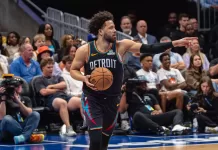

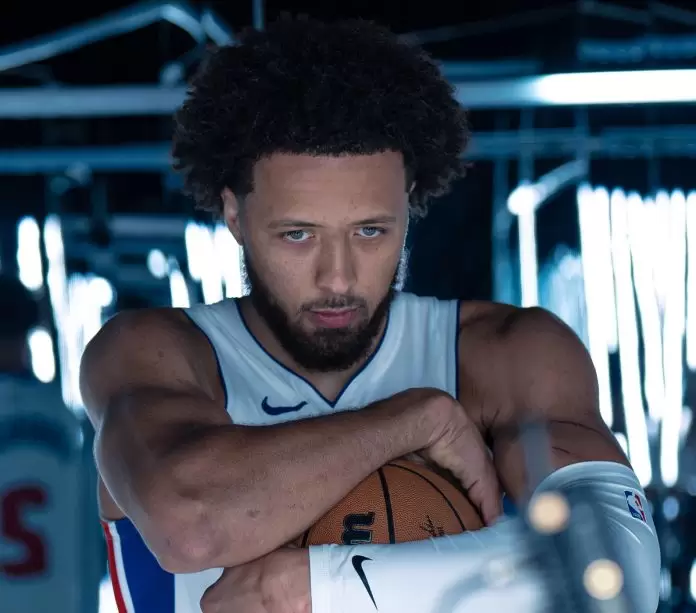
Young NBA players rarely get to grow without constant attention. Whenever someone has a big game, people start comparing, and any flaw becomes a topic of debate. For Cade Cunningham, who is seen as the future of the Detroit Pistons, one name keeps coming up as his career unfolds: Brandon Roy.
This comparison is based more on style than statistics. It’s about how Cunningham sets the pace, outsmarts defenders, and helps his team win in ways that aren’t always reflected in the box score.
Why Brandon Roy’s Name Still Carries Weight
Brandon Roy didn’t spend much time in the NBA, but he sure made people remember him. When he was at his best, he did it all—scoring from anywhere, finishing with either hand, never rattled when the game got tight. He wasn’t the fastest guy out there. He just knew how to play, had the moves, and made wise choices. That’s the kind of thing that makes people think of Cunningham when they talk about Roy.
“I mean, Brandon Roy, he was a legend in my eyes,” Cunningham said. “He was special — to do it all. Both hands, inside, outside game. So to even be compared, I feel honored. I think it’s a cool comparison. I’ve definitely tried to implement things from his game into mine.”
The admiration feels genuine, not rehearsed. Cunningham isn’t chasing nostalgia; he’s studying it.
Respect From the League’s Inner Circle
Fans aren’t the only ones making the comparison. Veterans such as Channing Frye, Kevin Garnett, Richard Jefferson, and Michael Redd have all noticed similarities in Cunningham’s poise and command. Roy himself also recognized these traits in a recent conversation earlier this year.
“There are similarities,” Roy said, pointing to how Cunningham reads defenders and operates in tight spaces.
MORE FOR YOU
“There are similarities,” Roy said, pointing to how Cunningham reads defenders and operates in tight spaces.
Vince Carter echoed that confidence in Cunningham’s trajectory.
“I like Cade,” Carter said. “I think he has a chance to be very good, and he’s gonna be a perennial All-Star, in my opinion.”
Those aren’t casual compliments. They’re endorsements from players who recognize control when they see it.
A Game Built on Control, Not Chaos
Cunningham’s game isn’t flashy. He doesn’t chase highlight reels or rely on jaw-dropping dunks. What sets him apart is his balance, his strength, and the way he waits for the right moment. At 6-foot-6, he can see above defenders and just lets the play come to him. Honestly, Isaiah Stewart summed it up better than anyone.
“I think Cade’s game is Cade’s game,” Stewart said. “Smooth operator. You can find some similarities, obviously, but his game is his game.”
That distinction matters. Roy often attacked as a scorer first. Cunningham operates as a conductor, comfortable initiating offense, reading help defenders, and sacrificing personal numbers for the right play.
Similar, Different, and Still Unstoppable
Houston Rockets analyst Ryan Hollins offered perhaps the most layered perspective — honoring both players without flattening their differences.
“They’re different players,” Hollins said. “Cade is a natural point guard. Brandon Roy was more in the playmaker category. But both are uniquely unstoppable.”
Hollins also reminded people of Roy’s dominance before injuries changed his career — a history that gives the comparison even more weight.
Becoming the Standard, Not the Echo
Comparisons can hold a player back or push him forward. Cade Cunningham’s all in on the second option. He watches Roy’s footwork, pays attention to his patience and how he moves in space, then figures out how to make those things work for him. One day, people won’t line him up next to Brandon Roy—not because the echoes disappear, but because Cunningham’s own achievements will set the standard. Right now, the comparison isn’t a burden. It’s a nod. And Cade’s using that as motivation.