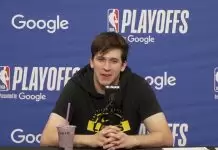

Austin Reaves didn’t sugarcoat what has become the defining issue of the Los Angeles Lakers’ Western Conference semifinal series against the Oklahoma City Thunder: the gap between their first-half competitiveness and second-half collapse.
After a 131-108 Game 3 loss at crypto.com Arena, Reaves focused on execution, adaptability, and a recurring breakdown that has swung the series heavily toward the defending champions.
“Yeah, I mean they’re a connected group. Their pieces fit basically perfect. So it’s just tough to beat them.”
The Lakers guard credited Oklahoma City’s structure and balance, pointing to how difficult it is to consistently disrupt their system when rotations shift and pressure increases.
“They got a good coaching staff over there that does a good job managing the game the way the team needs the game to be managed, and they got really good players.”
The Thunder, led by MVP-level production from Shai Gilgeous-Alexander and breakout performances like Ajay Mitchell’s 24-point, 10-assist Game 3, have now outscored Los Angeles by a wide margin in third quarters across the series.
Reaves acknowledged the pattern directly when asked whether Oklahoma City always seems to have an answer.
MORE FOR YOU
“I mean, you could say that. Thought we played really good first half, even a little bit in the third quarter. It’s kind of been the trend the last couple games. Just got to figure out how to take that first half and move it to the second.”
That inability to maintain control after halftime has become the central problem. Across the first three games, the Thunder’s third-quarter surge has erased Lakers’ progress and flipped momentum permanently.
Reaves admitted there is no simple explanation for the swing.
“I’ll have to watch the film.”
Oklahoma City’s defensive pressure has been a recurring theme, with Reaves referencing their ability to “blitz” and speed up possessions at critical moments.
The Lakers have repeatedly entered halftime in position to compete, only to see the game shift within minutes of the restart. Reaves highlighted both tactical and emotional challenges in handling those stretches.
“That’s basically the same question. If I had the answers, we would not struggle with it.”
The statistical reality has been just as stark as the eye test. The Thunder have consistently controlled the third quarter, using depth, pace, and defensive rotations to force errors and accelerate scoring runs that Los Angeles has been unable to match.
Even with LeBron James and Reaves combining for playmaking duties, the Lakers’ offense has struggled to sustain efficiency when Oklahoma City tightens its defensive coverage and limits second-chance opportunities.
Despite falling into a 3-0 series deficit, Reaves emphasized that the group has not lost its competitive intent.
“Yeah, I mean you just come and compete. There’s a bunch of guys in this locker room that are competitors.”
He also framed the response for Game 4 in clear terms, focusing on effort and responsibility rather than scenario thinking.
“The message after the game was we’re going to come in here Monday and we’re going to get a win. Obviously the situation sucks, but that doesn’t give us the license to quit.”
The Lakers now face elimination in Game 4, with Oklahoma City one win away from advancing behind a 7-0 postseason run that has exposed every gap in Los Angeles’ second-half execution.
Reaves’ final message pointed toward accountability and urgency rather than narrative.
“We got to come in here and compete. We owe the organization that, we owe each other that, we owe our fans.”
With the series shifting again to Monday night, the Lakers’ challenge is no longer about adjustments alone, but about sustaining an entire 48-minute response against a Thunder team that has not yet blinked in this postseason.