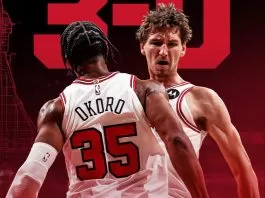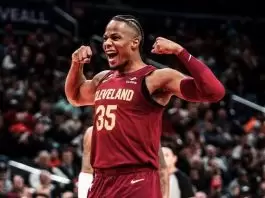
Isaac Okoro delivered a direct assessment of the season during his end-of-season interview on Monday, April 13, focusing on team performance, defensive responsibility, and the uncertainty surrounding roster direction. The wing also discussed his individual role and long-term mindset amid constant NBA movement.
Okoro framed the season around expectations and outcomes, making clear that the primary goal was not achieved. “I know for me, the team goal is to make the playoffs. So, for me, I look at it as a season that’s not a success.”
He expanded on that standard, linking it to his broader definition of competitiveness in the league. “Making the playoffs, getting far in the playoffs, looking to win championships. So when that’s not done, I look at the season as not a success.”
When asked about the team’s uneven year, Okoro described it as a difficult environment shaped by injuries and inconsistency, but stressed accountability over excuses. “This has definitely been a unique season. My most unique season yet. But it’s the NBA. You’re going to have guys that go down with injuries. Going to have limited players like that can’t be an excuse.”
He also pointed to execution in winnable games as a key factor in the final record. “We had games that we were in this year that we could have won. We had teams that we just didn’t come out with enough energy or enough competitiveness and they beat us.”
Okoro added that reflection after the fact does not change outcomes, placing emphasis on in-game performance. “So like go back and think right now like, oh, we should have won a game or we could have did this. But in the moment, you just got to be better.”
The conversation also turned to offseason uncertainty and potential roster changes, where Okoro kept his focus on controllable factors. “I mean, when you’re in a team that’s kind of just rebuilding everything, you don’t know what’s going to happen.”
He expanded on that approach, highlighting consistency in preparation regardless of external variables. “I just control what I can control, you know? I go into the offseason just trying to figure out how I could be a better player for the next season.”
Okoro also discussed his individual development priorities, emphasizing a multi-area approach rather than a single skill focus. “Just continue to become a better shooter. I feel like I’ve been getting better as the years go on. Finishing defense, you know, just playmaking, everything.”
Defensively, he reiterated his identity as a core part of his value on the court. “You know, like I said, I’m a physical defender. I go out there and I take pride in guarding the best players in the world and I feel like I do a great job at doing that.”
On trade uncertainty and league-wide movement, Okoro acknowledged the business side of the NBA without shifting his approach. “No one knows what’s going to happen. Like at the end of the day, it’s a business.”
He added perspective on league volatility, referencing recent high-profile moves as context for his mindset. “We all seen Luka get traded. Like no one’s safe in this league.”
Despite the uncertainty, Okoro closed on a consistent theme of control, preparation, and day-to-day focus heading into the offseason. “You just play like it’s your last.”