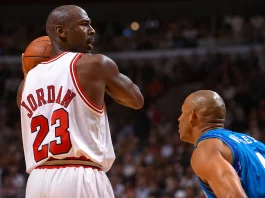
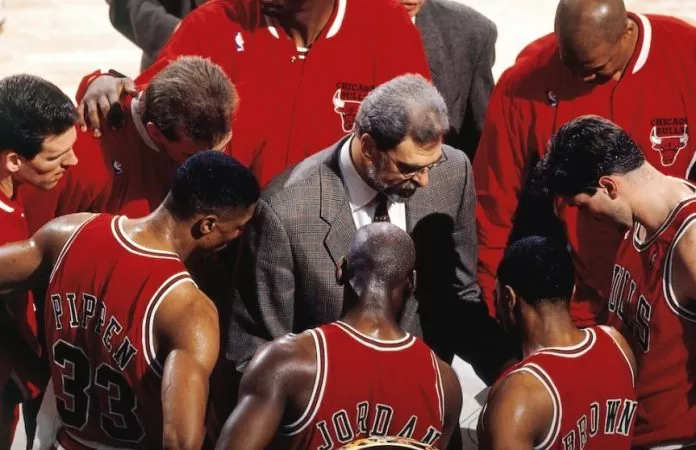
Former Chicago Bulls head coach Phil Jackson has recalled an early conversation with Michael Jordan in which he explained why the superstar needed to reduce his scoring responsibilities to give the team a better chance of winning an NBA championship.
When Jackson took over as Chicago’s head coach in 1989, Jordan had already established himself as the league’s most dominant scorer. However, the Bulls had yet to win a championship, and Jackson believed their offensive approach needed to change.
“When I was given the job as the head coach of the Chicago Bulls, I brought Michael Jordan in to speak with me, and I said, ‘You know, you’ve averaged 37, 38, 36 points a game the last three years. You know, you’ve been the scoring champion, but if you look back at the history of the NBA, there hasn’t been a scoring champion for almost 15 years who’s won the championship. They don’t go together.’”
Jackson wanted Chicago to become less predictable offensively, explaining that opponents had built their defensive strategies around stopping Jordan. His solution was to involve the rest of the roster more frequently.
“‘And we need to take the focus off you, which is what teams now tilt their whole defense towards, stopping Michael Jordan, and open it up for the rest of our team. And it means you taking less shots a game. That’s important.’ And he stopped me and he said, ‘Are you going to run an equal-opportunity offense like Tex Winter’s been talking about?’”
Jackson confirmed that he intended to introduce a system in which players would make decisions based on what happened on the court rather than relying on plays called from the sideline.
Nevertheless, he assured Jordan that the offense would still be designed to put the ball in his hands when the team needed a basket.
“I said, ‘Yeah, I guess you could call it an equal-opportunity offense, but I’m not going to be calling the plays from the sideline. You guys are going to be reading it on the floor. So if the 24-second clock is running down and it becomes red, which is the call everybody makes when it’s under five seconds, we’ll teach the team how to get the ball to you at the end of that clock because then you can score.’”
Jordan initially questioned whether he needed to sacrifice his scoring numbers, arguing that he could remain the league’s leading scorer while playing within the new system.
“He said, ‘Well, I don’t think that I have to give up a scoring championship. I could score 32 points a game and still win a scoring championship. That’s only eight points a quarter.’ I said, ‘Michael, I had trouble scoring eight points a game when I was a player.’”
Jackson then proposed a different approach: rather than focusing on scoring consistently throughout the game, Jordan could conserve more of his offensive responsibility for the final quarter.
“‘But rather than scoring eight points a quarter, why don’t you save that for the fourth quarter and score 14 points in the fourth quarter and take us home? And you can do what you want to do during the early part of the game and then put the onus and the nail in the coffin in the fourth quarter to seal the deal.’ He kind of liked that idea.”
According to Jackson, the Bulls initially struggled to adjust to the new offensive philosophy, which emphasized ball movement, teamwork and independent decision-making.
“And, you know, I think we lost two or three of our first games that we played in my first year coaching, and everybody had to kind of figure out how to do it, how to play together when the ball was dictating the action, when the passes were dictating what people would do, rather than a specific number for a player being called from the sideline. And I gave the team a little bit of authority, which is exactly what a coach wants to happen.”